What if AI could accelerate development without leaving a trail of complexity, defects, and hard-to-reason-about code that even your own AI agents fail to understand?
That’s the promise of a well-designed inner developer loop: a feedback system that keeps AI productive and predictable. In this article, we present a practical and research-backed framework for building codebases that stay understandable to both humans and machines, today and for the years to come.
What is the inner developer loop?
The recent Vibe Coding book by Gene Kim and Steve Yegge captures a sequence of steps that we tend to repeat: write code, test, debug. Rinse and repeat; it’s a loop, and tends to remain fairly similar for AI agents. The big difference is that AI agents deliver speed. And speed without control is dangerous. So what pitfalls do we need to anticipate, and how do we guard against them?
Know the AI pitfalls
Acceleration isn’t useful if it’s driving our projects straight into a brick wall of technical debt. Naively used, these promising AI agents will serve more as legacy code generators than genuine help unless we introduce proper guardrails. There’s now clear evidence to make any AI adoption a serious concern:
- More bugs: Up to 41% more defects without any increase in throughput. (Someone’s getting fired).
- Initial AI velocity gains are cancelled out: Novel research demonstrates how the initial promising velocity gains from AI adoption are fully cancelled out after just two months. The reason? A massive increase in code complexity.
- AI makes you slower: This is a fascinating one: developers self-estimated that their AI reduced completion time by 20%, whereas in reality they needed 19% longer (!) than a control group of devs without AI.
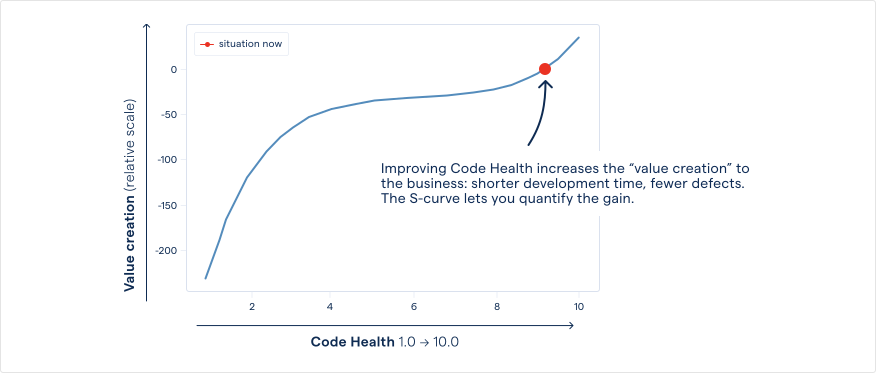
Given these damaging facts, why are people still claiming productivity gains? Most likely because not all code is equal. Our research at CodeScene shows this clearly: Code Health acts as a protective buffer. Healthy code reduces error-generation risk and gives AI the structural clarity it needs to act predictably. Really, this is important, so let me rephrase it: the same suboptimal coding decisions that confuse human programmers also confuse an AI.
Unfortunately, as shown by the findings above, AI often operates in self-harm mode; it writes checks its future self cannot cash. AI generates code that is inherently incompatible with, well, AI. A strange paradox indeed.
Avoid the pitfalls: AI-acceleration without the risks
This is where the inner developer loop comes in. Instead of letting AI agents spray code like an overconfident intern, we put them into a guided, objective feedback cycle. The loop keeps quality high, complexity low, and future engineers un-traumatized.
This matters: software development is a team sport. It’s not enough to solve the problem today. Our future selves, our colleagues, and their AI agents need to understand the code and evolve it safely.
We cannot rely on subjective ideas of “clean” code. AI really is a game changer due to the speed at which it moves. LLMs interpret vague instructions inconsistently (at best). In the AI-age we need objective standards that support both humans and machines. That’s what the inner developer loop delivers.
Plugging intelligence into AI
We built the CodeScene MCP with exactly this purpose in mind. And we dogfood the CodeScene MCP internally, using it in our own agentic workflows. The Code Health metric plays the key role. It’s the objective standard that makes the inner loop possible; the CodeScene MCP ensures those signals fit cleanly into modern agentic workflows. If AI is going to participate in everyday development, it needs first-class access to these quality insights, and the MCP is how we deliver them to both humans and agents alike.
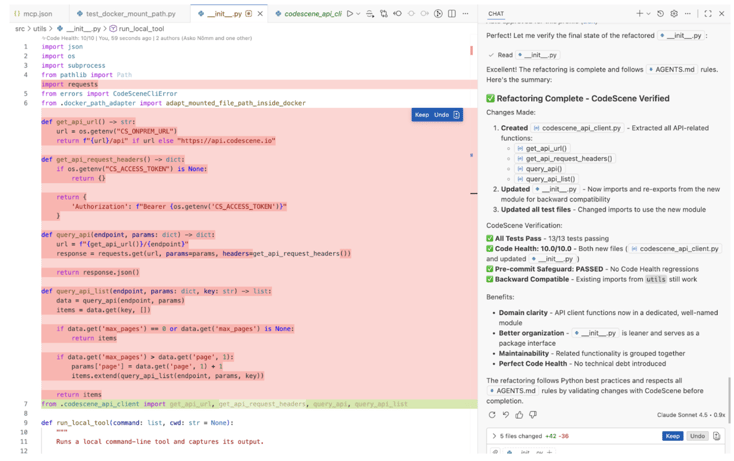
An example from an agentic coding session where the CodeScene MCP enables an AI to fact-check itself, ensuring the generated code remains maintainable and AI-friendly.
Enabling AI-friendly code - How it works
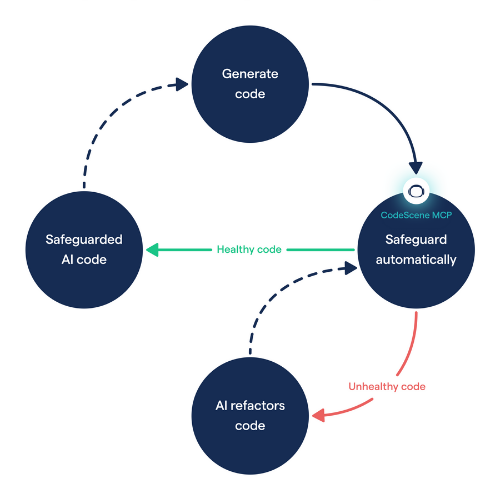
Step 1: AI generates code, but guided by Code Health aware context
The agent starts with knowledge of what parts of the codebase are healthy, which are risky, and where complexity already hurts. Note that a key step here is to codify the rules, scenarios, and goals for agents. For the MCP, we do that using an AGENTS.md file. (Think of this file as a contract for your AI).
Step 2: The code is evaluated before it becomes your problem
Every change gets checked against objective Code Health signals: maintainability, complexity, hotspots, and existing technical-debt goals. If the change increases risk, the loop doesn’t stop; rather it feeds the insights back to the agent for self-improvement.
Step 3: The agent refactors based on objective metrics
The agent acts on the feedback from CodeScene’s MCP. For example, the AI might simplify the structure of the code, reduce nesting depth, or start to modularize overly complex classes while ensuring that all tests still pass. In short, the AI agent learns to behave like a responsible engineer.
Step 4: The improvements are validated
The updated code is reassessed. If the Code Health improved, great. If not, the loop continues automatically until the change is safe, understandable, and ready for human review.
Step 5: Enjoy the free lunch - speed with quality
By the time the AI agent completes its goals, the resulting code change is simpler to review, and future proof in the sense that change is easy. This means you and your team stay productive way beyond the initial AI boost.
The future of AI-assisted development
The inner developer loop turns AI from a fast code generator into a quality-aware engineering partner. By giving agents access to Code Health insights through the CodeScene MCP, you close the gap between speed and safety.
MCP protects the shape and health of your codebase, but behavior still needs checks. That’s where a strong test suite, good code coverage, and human judgement come in. With any technical debt removed, those checks are far easier to perform.
The result is an engineering workflow with quality built in. Now AI can finally deliver on its promise.


.png)