“AI must improve customer experience or business value — and ideally both — while measurably improving developer experience and efficiency.”
-
 Prompting alone didn't hold the line. Agent output kept slipping past human review,
and Code Health Hotspots dropped.
-
Unguarded complexity compounds fast. Code that looks fine on the surface quickly
becomes painful to change.
-
The business impact had to be provable, not assumed. Leadership needed a way to
show that AI adoption was paying off in delivery efficiency, not just something
developers felt was happening.
“We were trying to use prompting techniques in agent files to encourage the LLMs to do the right thing. It didn't really work, because they just sort of do their own thing. So the code inevitably degraded as it got through human checks and went into our system, our Code Health Hotspots were dropping.”


.svg)


-
A deterministic quality bar, not a suggestion. The team set a CodeScene CodeHealth score of 9.8 as the minimum for existing code to be considered healthy enough to hand to an LLM at all, treating both legacy code and AI output as potential sources of "garbage in."
-
CodeScene CLI as a commit-hook backstop. Agents.md instructs agents to keep code health at 10.0, and the CLI enforces that as a commit hook, closing the loop on agents "cheating" or goal-seeking past the quality bar, and throwing work back before it can land.
-
CodeScene's CodeHealth MCP Server inside the agentic loop. It feeds code health context to the agent at the point it writes code, not just after the fact. Output that falls below 10.0 triggers a refactoring loop until the code clears the AI-ready bar.
-
Measuring the impact with CodeScene. An adoption/cost/impact framework from day one. loveholidays measured AI's rollout across three dimensions — adoption, cost, and impact — treating impact as the metric that mattered most. CodeScene enabled that.
-
Team leaderboards as a culture mechanic. Making code health and AI adoption visible team-to-team turned quality into friendly competition rather than a top-down mandate.
“Putting these hard guardrails in place was the game changer, forcing the agent to build the code at the structural quality that we wanted, and brought the code health back up. ”
-
80% of all commits are now agent-assisted, already past the 72% internal target. It's organisation-wide,
not just one department.
-
A code health dip reversed within days of adding the CodeHealth Safeguards. Critical code health
recovered.
-
70% of teams at AI-ready Hotspot Code Health (>9.75), 88% "healthy’" at 9+, reaching top 5% of the industry.
industry. Code quality is rising, not falling, as AI adoption scales.
-
The guardrails in place enabled the teams to shift left. Build reliability improved as adoption scaled. AI
build success rates now sit above 90%, Change failure rate stayed near 1–2%, well under the 5% "DORA Elite"
threshold even as AI-assisted commits rose.
-
Deployment frequency grew 20–30% year-over-year. PR merge volume kept climbing, and time-to-merge
stayed stable, even as agent-assisted commits rose.
-
Teams with better quality code (AI-ready code) adopted AI more rapidly than their peers. The CodeHealth MCP
ensures AI-touched code stays healthy, and the CodeHealth metric gives teams a defined threshold for what
counts as AI-ready.
-
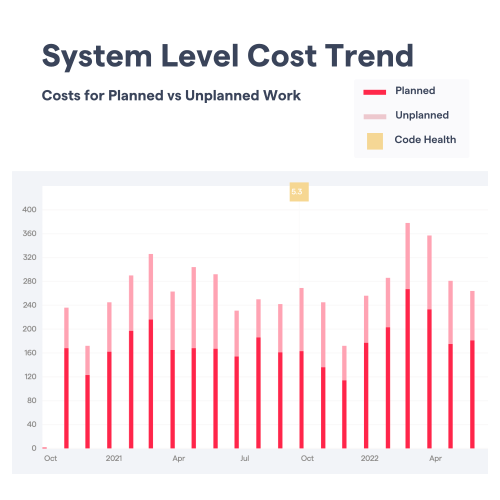
Healthier code is measurably cheaper to run through AI. When agents operate on code below the CodeScene 'AI-ready' threshold, it doesn't just raise the defect risk, it costs significantly more to run.
-
Average code health rose system-wide, not in isolated pockets. The share of AI-ready repositories grew
steadily across the whole estate.
“We have truly increased our use of AI. 80% agentic-assisted code is not only in one department, but all over our engineering. The discipline is to keep the systems AI ready as per CodeScene.”