<img src="https://secure.leadforensics.com/794635.png" style="display:none;">
PR Refactoring Agent background
New release

PR Refactoring Agent

Reviewers can now trigger guided refactoring directly from pull requests. The agent analyzes the branch using deterministic Code Health data, performs targeted refactorings and commits improvements back to the PR.

The result is code that is easier to review, AI-friendly and more token efficient. And yes, we support all those promises with data.

The problem

Refactoring rarely wins against feature pressure

Even when teams want to improve the code, refactoring is a specialized skill that takes time and experience to develop. That is why many maintainability issues remain in codebases long after they start hurting delivery speed and increasing defect rates.

The risk

Unhealthy code will become a bottleneck for agentic development

Agents depend on explicit structure and intention-revealing code. Unhealthy code increases defect risk, wastes tokens and makes AI-generated changes hard to verify.

The solution

Deterministic Code Health as a shared ground truth

Instead of relying on custom prompts or subjective preferences, the agent refactors based on deterministic Code Health signals and measurable targets, inside the review flow where your team already works.

60%

Defect risk when agents operate on unhealthy code.

Read the research

9.5+

Code Health score that dramatically lowers break rates during AI-assisted change.

See the research

50%

More tokens consumed by agents on unhealthy code, varies by programming language.

See the data
How it works

Built into your existing review flow

The workflow is centralized in CI so reviewers can use the agent without every developer installing local AI tooling. Everything happens inside the review flow, where the whole team can inspect the changes, evaluate the outcome and decide whether to accept the improvements.

A reviewer triggers the agent

Post a /cs-agent comment on a pull request or merge request, or click the Fix Code Health degradations button directly in the PR.

The workflow validates the requested action and model

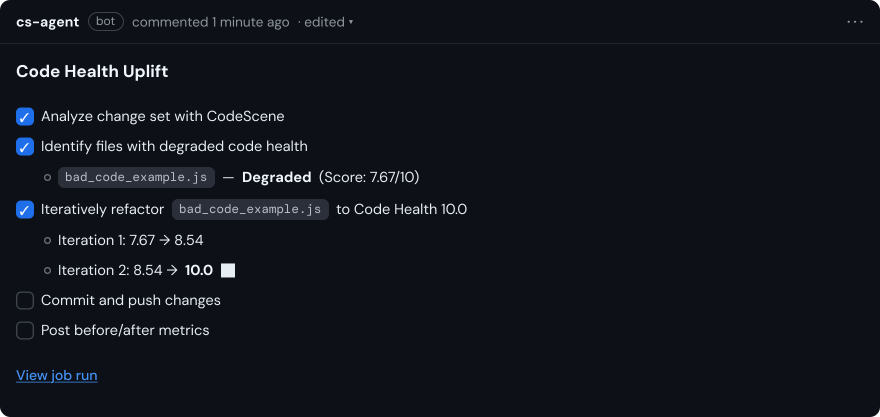
The agent analyzes the pull request branch with CodeScene data and performs the requested refactoring workflow.

Progress is reported back to the PR in real time

You can follow the refactoring as it happens, directly in the pull request.

Generated improvements are committed back to the branch

Changes are pushed to the same branch and remain subject to normal review and approval. Nothing bypasses your process.
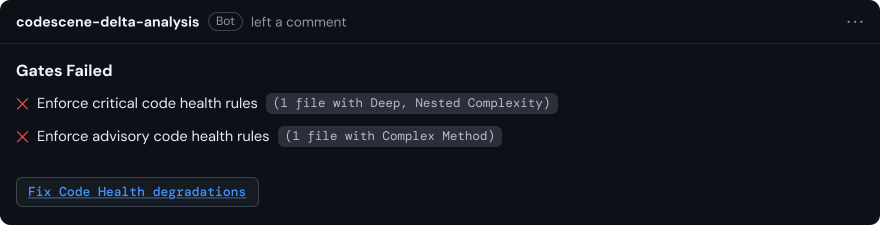
PR Refactoring Agent in a pull request

A centralized workflow for maintainability governance

The PR Refactoring Agent offers a centralized workflow that integrates directly into the review process where teams already collaborate. It replaces ad hoc review preferences with a shared, objective bar for code quality, tied to real engineering outcomes like delivery speed, defect risk and AI-readiness.
01
A reviewer triggers the agent from a pull request or merge request comment.
02
The workflow validates the requested action and model.
03
The agent analyzes the branch using Code Health data and performs the requested refactoring workflow.
04
Progress updates are reported back to the PR. Generated improvements are committed directly back to the same branch.
Workflows

Two workflows out of the box

Use Code Health as a shared bar for refactoring instead of relying on ad hoc review preferences.
Workflow 1

Fix Code Health degradations

Automatically refactor the maintainability issues introduced in the current PR. The agent limits itself to new degradations and avoids modifying previously existing issues elsewhere in the codebase. This keeps the workflow focused, reviewable and safe to adopt incrementally.
skill:fix-code-health-degradations
Workflow 2

Uplift any code

Target a specific Code Health score and let the agent guide the refactoring process toward that structural goal. By default, the agent aims for the next meaningful improvement step, for example from 5.2 to 6.0. Teams can raise the bar further and target AI-friendly code at 9.5 or even an optimal 10.0.
skill:uplift-code-health

The agent is extendable

The two built-in workflows cover the most common scenarios, but the agent lets you extend its behavior with workflows customized for your organization. You just add a skill capturing your scenario and context, making it a flexible foundation for maintainability governance at scale.
“Instead of relying on custom prompts or subjective preferences, the agent refactors based on deterministic Code Health signals and measurable targets. Your code deserves that.”
Adam Tornhill, Founder and CTO, CodeScene
Why deterministic guidance matters

AI coding tools are probabilistic by nature, Code Health is not

The PR Refactoring Agent uses Code Health as a deterministic ground truth to guide and validate its behavior. Rather than guessing what better code means, the agent works toward explicit structural improvements that are measurable, reviewable and outcome-focused.

Healthy code significantly reduces AI-induced defect risk

A Code Health above 9.5 dramatically lowers break rates during AI-assisted change, a measurable outcome, not a best-practice claim.

A consistent bar across every pull request

Code Health replaces ad hoc review preferences with a shared, objective signal tied to real engineering outcomes: delivery speed, defect risk and AI-readiness.

Healthy code reduces unnecessary token consumption

Unhealthy code is burning your token budget. Agents operating on unhealthy code consume significantly more tokens. Improving Code Health makes AI workflows more efficient and more predictable.

Privacy and security

Control stays with your team

The PR Refactoring Agent keeps the existing pull request review process intact while giving administrators control over the execution environment.

Source code stays on your runner

Source code is processed only as part of the pull request workflow run, using the selected model provider configured for that environment. The CodeScene agent does not send source code to any other third party.

Administrators control which models the agent can use

Credentials are managed as CI secrets. Teams choose providers that match their security and compliance requirements.

All changes remain subject to normal review and approval

Any code changes made by the agent are pushed back to the pull request branch. Your team inspects the changes, evaluates the outcome and decides whether to accept the improvements.

Self-hosted options for stricter requirements

For stricter data residency and governance requirements, the agent can be run with self-hosted model providers and a self-hosted CodeScene instance so code stays within your environment.

Verification responsibility stays with your team

Using the PR Refactoring Agent does not transfer ownership of change quality away from the pull request author. Treat agentic changes the same way you treat any other contribution: run your tests, perform your standard CI checks and review before merging.

Try it out and share your feedback

Available now for GitHub Actions and GitLab CI. Existing CodeScene users can activate the agent as documented. New to CodeScene? Start your free trial.